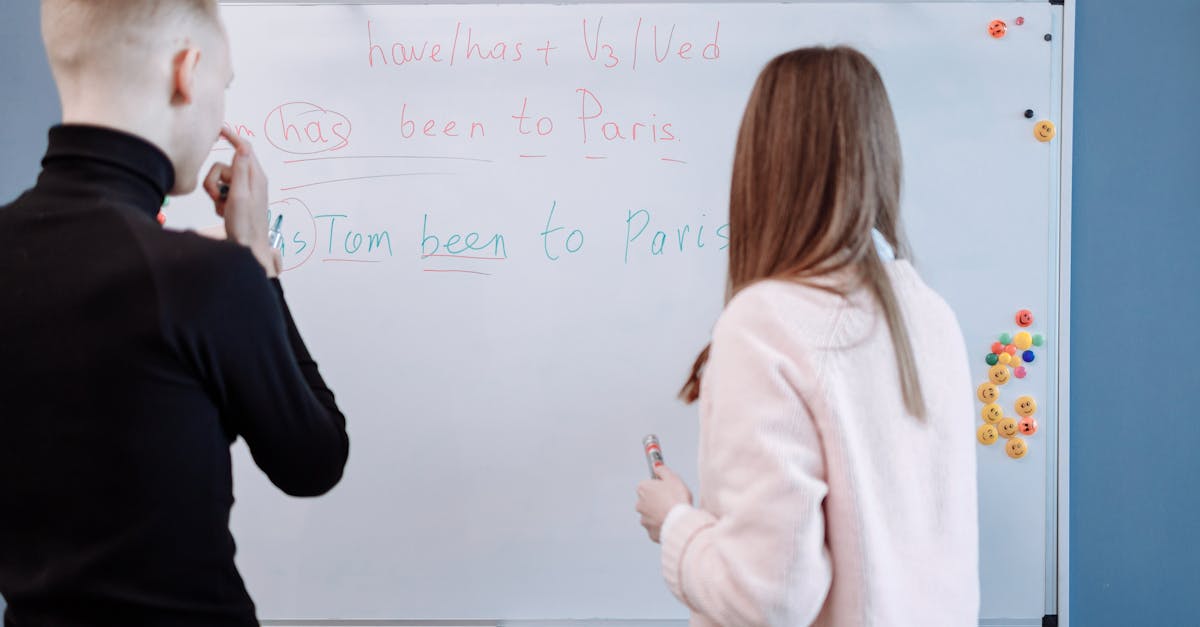
English Tenses
Using Tenses in English
Écoutez le texte du cours.
🎧 Read/Listen first
In English, we use different tenses to talk about time. The present simple tense is used for habits and facts. For example, "I eat breakfast every day." The past simple tense is used for actions that happened in the past, like "I visited my friend yesterday." The future tense is used for plans, such as "I will go to the store tomorrow." Understanding these tenses helps us communicate clearly about when things happen.
⚡ Learning goals
- Understand basic tenses
- Use tenses in sentences
- Talk about past and future actions
🔑 Key language
- I eat breakfast every day. Present simple for habits.
- I visited my friend yesterday. Past simple for past actions.
- I will go to the store tomorrow. Future tense for plans.
🌍 Global comprehension
AI writing analysis
Task: Write a sentence using the future tense.
Use 'will' and a verb to describe a plan.
Success criteria: Correct use of future tense.
- will
- go
- store
- future tense
- simple verbs
✍️ Vocabulary
🧠 Flashcards interactives
Choisissez la bonne réponse, écoutez le modèle, puis répétez à voix haute.
⚙️ Rules & Grammar
🟣 Present Simple Tense
Rule:
The present simple tense describes habits and facts. We use it for actions that happen regularly. For example, "I play soccer on weekends."
- I read books every night.
- She works at a bank.
- Using 'is' instead of 'am' with 'I'. → Say 'I am' not 'I is'.
- Forgetting to add 's' for he/she/it. → Add 's' to the verb for he/she/it.
🟣 Past Simple Tense
Rule:
The past simple tense describes actions that happened in the past. We often add 'ed' to regular verbs. For example, "I walked to school."
- She visited her grandmother.
- They watched a movie.
- Using present tense for past actions. → Always use past tense for actions that are finished.
- Forgetting irregular verbs. → Learn the past forms of irregular verbs.
🟣 Future Tense
Rule:
The future tense is used to talk about plans. We use 'will' plus the base form of the verb. For example, "I will travel next year."
- She will study abroad.
- They will visit us next week.
- Using present tense for future actions. → Use 'will' for future plans.
- Forgetting to use the base form of the verb. → Always use the base form after 'will'.
🟣 Using Time Markers
Rule:
Time markers help us understand when actions happen. Words like 'yesterday', 'today', and 'tomorrow' are important. For example, "I went to the store yesterday."
- I will call you tomorrow.
- She visited her friend today.
- Not using time markers. → Always add time markers for clarity.
- Confusing past and future time markers. → Use 'yesterday' for past and 'tomorrow' for future.
🧩 Guided practice
Mini-dialogue:
In class, we learn about tenses. The teacher explains the present, past, and future tenses. We practice using them in sentences. It helps us communicate better.
Why this matters:
Understanding tenses is important for clear communication. It helps you express when things happen.
Verb & Adjective Pack:
Use the present for habits, past for completed actions, and future for plans.
AI oral analysis
Oral task: Write a sentence about your future plans.
Use 'will' and a verb to describe what you will do.
Success criteria: Correct use of future tense and clarity.
- will
- go
- store
- future tense
- simple verbs
🚀 Quick challenge
Listen to the model, repeat aloud, then retry to improve your score.
AI Conversation Mission
You are talking about your plans with a friend.
- Describe your weekend plans.
- Ask about their plans.
- Share a past experience.
Use clear time markers.